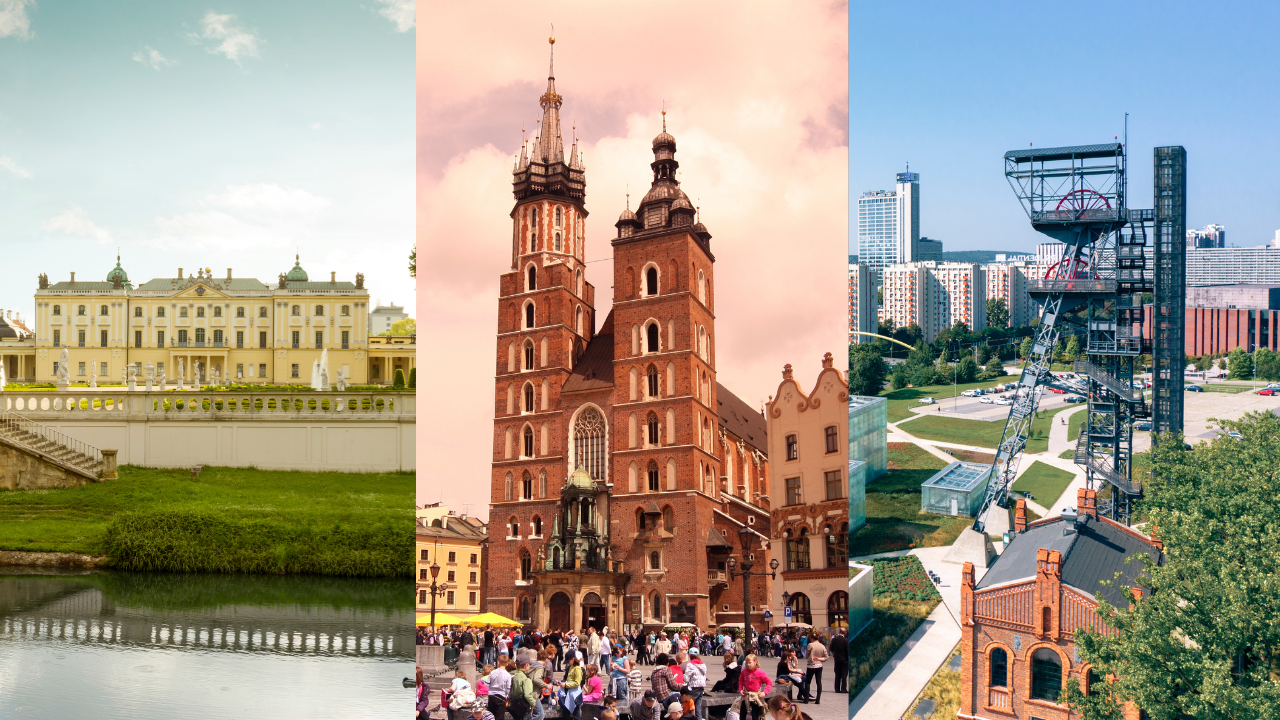
Between 20-25 September 2026, Natolin students of the Johannes Gutenberg Promotion will take part in the First Semester Study Trips to three destinations under the overarching theme of "Borderlands". Discover more about the destinations and study trip programmes below:
-
Podlasie and Suwalszczyzna as a Borderland: Contact Zone Between Political Orders, Cultures, and Strategic Imaginations
Podlasie is a region where questions of statehood, military geography, religious coexistence, imperial rivalry, forced displacement, memory, resilience, and modern deterrence have long intersected. Podlasie and the wider north-eastern frontier of Poland can be understood as a contact zone between political orders, empires, religions, languages, and strategic imaginations.
The study trip will provide a way to connect historical borderland politics with present day European security debates: deterrence, resilience, infrastructure vulnerability, hybrid operations, border management, memory policy, minority relations, and the protection of cultural and natural heritage all under geopolitical pressure. Geopolitical considerations continue to affect the region today and take different forms: The Polish and Lithuanian borders are also the external borders of the EU and NATO. Squeezed between Russia and Belarus, the 65-km wide Suwałki corridor is the only land connection linking the Baltic states with Poland and the rest of their NATO allies. The border with Belarus has various dimensions, including Białowieża as a borderland of nature, and hybrid pressures. Most prominently, Lukashenko has responded to EU sanctions by creating a migration crisis at the Lithuanian and Polish borders.
-
Galicia: Empires, Memory, and Security on Europe's Edge
This study trip will invite students to explore several cities of the former Galician territory, and to reflect on the contemporary dimension of the region. The trip focuses on some of the key phenomenon of Borderlands, as Galicia represents a particular space of memory for Poles, Ukrainians, Austrians, and Jews that are now separated by borders. Students will have the opportunity to learn and compare the divergent perceptions of Galicia, once representing merely a term created to denote the territory on the margins of the Habsburg Monarchy in 1772, then disappearing from political maps in 1918, only to become a fragmented territory once again. Yet, Galicia is still present as a mythical place going beyond both physical and time frontiers.
In addition, this year's study trip places renewed emphasis on Galicia as a borderland of empires, strategy, and security: a region whose contested position between competing powers did not end with the collapse of the Habsburg Monarchy, but continues to shape how the area is defended, governed, and lived in today. The current war in Ukraine has turned the former Galician territory into a frontline of humanitarian response and civilian resilience, giving students a direct, contemporary lens onto questions of infrastructure vulnerability, cross-border cooperation, and the strategic significance of a region long treated as peripheral.
-
The Many Silesias: Identities, Memories, Transitions
This study trip will seek to familiarize students with the multiple identities and historical trajectories of the region of Silesia, its role as a historical and contemporary borderland, and its various transitions from one realm/state to another, from totalitarianism to democracy, from an economy based on fossil fuels and industry to a climate-neutral and ecologically friendly one.
Silesia is a model example of borderlands. Its main centres are Wrocław, the historic capital of Silesia, in Lower Silesia and Katowice in Upper Silesia. Yet, the region extends geographically, economically, mentally, and culturally beyond contemporary Polish borders into Czechia and Germany. Furthermore, as formal borders have moved and cut across the region in ever-changing ways, people have not always followed, despite episodes of expulsion and relocation. “Silesia” is thus not merely a piece of land but a scene of shared complex fate and home to a separate, independent identity.
The study trips are an integral part of the academic programme of the Department of European Interdisciplinary Studies. To learn more about the different destinations and topics of the previous study trips organized for Natolin students, click here.
Regular updates on the study trips will be published on our social media – follow us on Instagram, LinkedIn, Facebook and X and look for #NatolinOnTour!