Leading beyond expertise: why human skills matter more than ever
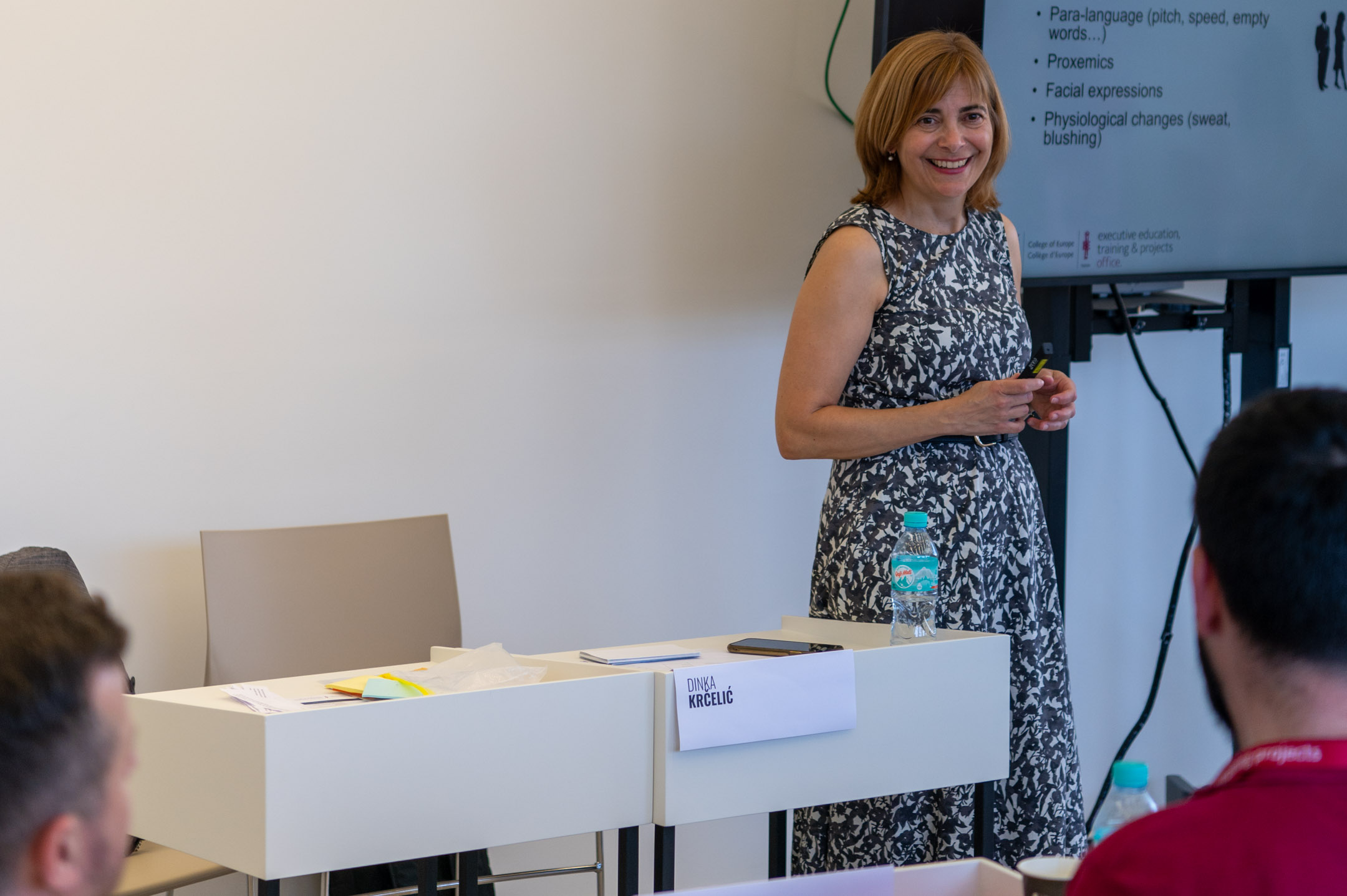
In today’s rapidly evolving European and global environment, technical knowledge alone is no longer enough. Professionals working across EU institutions, public administration and international organisations are increasingly expected to manage complexity, build trust, and lead teams through uncertainty and change.
This is precisely the ambition behind the EU Skills programme at the College of Europe - a course designed for professionals to strengthen the human and collaborative skills that are becoming essential in today’s policy and institutional landscape.
We spoke with Dinka Krčelić, Course Advisor, College of Europe alumna and Visiting Professor, about why these skills matter more than ever and what participants can expect from this training course.
According to Krčelić, one of the biggest shifts in recent years is the growing importance of human-centred leadership.
“Professionals are still expected to deliver expertise and results, but they are also increasingly asked to lead people, navigate diverse stakeholder interests and build cooperation across institutions and cultures.
In fast-moving and politically complex environments, leadership is no longer only about hierarchy, processes or decision-making. It also requires self-awareness, emotional intelligence, communication skills and the ability to create trust within teams.
The EU Skills executive education training was created with exactly this challenge in mind. Through practical work on communication, teamwork, negotiation and trust-building, participants are encouraged to step back from the pressure of everyday work and reflect how they lead and collaborate.
As Europe continues to evolve, we need leaders who can connect people, inspire collaboration and transform uncertainty into purpose and collective action.”
What are the most critical skills for professionals working in the EU environment?
“Working in the EU environment often means operating across a diversity of cultures, mindsets, languages and competing political priorities. In that context, technical expertise alone rarely guarantees success, particularly when one moves from a technical expertise position to one entailing the management of a team.
Among the most important skills today are self-awareness, emotional intelligence and effective communication. Leaders must know how to build trust, work across institutions and engage diverse stakeholders constructively. Today’s challenges cannot be solved in silos, and professionals need to know how to collaborate across institutions, sectors and cultures, and how to engage stakeholders constructively.”
Strategic thinking, adaptability and negotiation skills are also increasingly important. Successful leaders are those who combine expertise with empathy, openness and the ability to create meaningful cooperation.”
What motivated you to join the programme as Course Advisor?
“Over the past 25 years, I have worked across public administration, EU affairs, capacity building and professional development, supporting institutions, organisations and individuals in strengthening skills and preparing for change. Recently I have been a part of the College of Europe Alumni Association mentorship network, and this has given me a chance to work with professionals at the EU institutions who are hoping to advance in their careers and are ready for leadership roles.
Throughout my own journey and by working with various professionals, I have increasingly realised that technical expertise alone is not enough for the next career step or for being successful in managing departments or organisations. Many professionals eventually reach a point where technical expertise is no longer enough: they need stronger communication skills, more confidence, greater self-reflection and the ability to lead people, not only processes.
That is what drew me to the EU Skills programme. For me, this is more than a training course, it is a leadership journey. A space where professionals can pause, reflect on their potential and prepare for the next stage of their careers.”
Join us in Bruges from 6 - 10 July 2026 to further your leadership skills! Registrations are open until 14 June.