Develop your own expertise in transatlantic affairs
The MATA master’s thesis gives you the opportunity to investigate a transatlantic question in depth and make an original, evidence-based contribution to your chosen field.
Worth 25 ECTS, the thesis brings together the knowledge, perspectives and research skills developed throughout the programme. Each student receives academic guidance from both partner institutions, with one supervisor from the College of Europe and one from The Fletcher School at Tufts University.
25 ECTS · Transatlantic focus · Two academic supervisors · Independent research
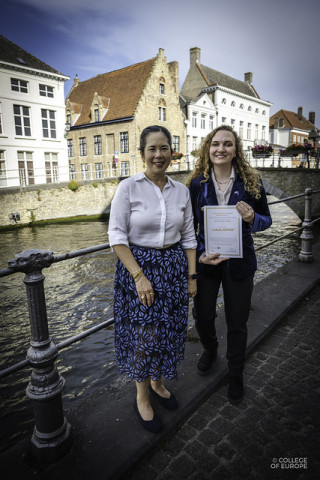
(Photo) Juliette Perrier, MATA ’25, receives the 2025 Jan Olaf Hausotter Memorial Prize for the Best Thesis in Transatlantic Affairs.
Bring together perspectives from both sides of the Atlantic
MATA students pursue thesis topics connected to their academic track, professional interests and evolving transatlantic challenges.
The thesis may compare European and American approaches, examine the relationship between the two, or investigate an issue with significant implications for transatlantic affairs. Students are encouraged to draw on the academic strengths and perspectives of both institutions.
Potential fields of research include:
- diplomacy and international relations;
- European and American politics;
- security and defence;
- trade, finance and economic policy;
- technology and regulation;
- climate and energy;
- democracy and human rights;
- migration and development;
- EU–US institutional cooperation;
- regional and geopolitical change.
These examples are illustrative. Each thesis must develop a clearly defined research question and meet the programme’s academic requirements.
What will you learn?
Through the thesis, you will learn to:
Define a focused research question
Transform a complex issue in transatlantic affairs into a clear, relevant and feasible research project.
Evaluate evidence critically
Identify and assess academic literature, policy documents, legal materials, data and other sources relevant to your subject and disciplinary approach.
Design independent research
Select appropriate concepts, theories and methods and apply them in accordance with academic and ethical standards.
Bring together different perspectives
Compare European and American viewpoints and, where relevant, integrate political, historical, legal, economic or regional dimensions.
Develop a sustained argument
Move beyond description to present a coherent, well-supported analysis that responds directly to your research question.
Communicate your findings
Present complex research clearly in writing and defend your approach and conclusions in an academic discussion.
These points reflect the programme’s formal learning outcomes in theoretical understanding, analysis of academic research, comparative institutional knowledge, interdisciplinary thinking, research design and evidence-based communication.
Your thesis journey
Thesis work extends across the two-year programme and develops alongside coursework, transatlantic mobility and—where students choose that route—the high-level internship.
1. Explore your subject
During the first year, you begin identifying a field of interest and considering how it relates to transatlantic affairs and your chosen study track.
2. Develop your proposal
With academic guidance, you refine your research question, identify the relevant literature and evidence, and formulate an appropriate research design.
Students submit a thesis proposal at the end of their first year.
3. Work with supervisors from both institutions
A primary supervisor is assigned through the institution or study track responsible for the first stage of the research. A second supervisor from the partner institution joins the supervisory process during the second year.
Together, the two supervisors help students benefit from complementary European and American academic perspectives.
4. Conduct and write your research
During the second year, you develop the analysis, maintain the required contact with your supervisors and complete the written thesis.
If you undertake an internship, your professional experience may help you refine your interests or understand how research is applied in practice. The thesis nevertheless remains an independent academic project, and all confidentiality and research-ethics requirements must be respected.
5. Submit and defend your thesis
Students submit the completed thesis and defend their research before completing the programme. Under the current programme structure, submission normally takes place in late March, followed by the defence in April. Exact dates are communicated for each academic year.
Guidance from both sides of the Atlantic
The joint supervision model is one of the distinctive features of the MATA thesis.
A College of Europe supervisor and a Fletcher supervisor bring different academic, disciplinary and institutional perspectives to the project. Depending on the subject, this can help students:
- compare European and American approaches;
- connect regional expertise with global debates;
- draw on complementary research traditions;
- refine the relevance of their research for transatlantic affairs;
- develop an argument that speaks to audiences on both sides of the Atlantic.
Recognising outstanding research
Jan Olaf Hausotter Memorial Prize for the Best Thesis in Transatlantic Affairs
The best master’s thesis submitted by a MATA student receives the Jan Olaf Hausotter Memorial Prize for the Best Thesis in Transatlantic Affairs.
Jan Olaf Hausotter was a graduate of both the College of Europe and The Fletcher School. He was working as a Political Affairs Officer with the United Nations Stabilization Mission in Haiti when he was killed in the January 2010 earthquake. The prize is sponsored by his former College of Europe classmates and commemorates his commitment to international public service and transatlantic understanding. It is presented at the College of Europe’s closing ceremony in Bruges.
2026 prize-winning thesis

A tale of transatlantic capital
Luca Magnier received the Jan Olaf Hausotter Memorial Prize for his thesis: A tale of transatlantic capital: The expansion of private equity in nursing homes in France and Germany (2008–2025)