Prof. Pascaline WINAND publishes volume chapter titled "The Performance of Regionalism in South Asia: SAARC and Beyond" with Routledge
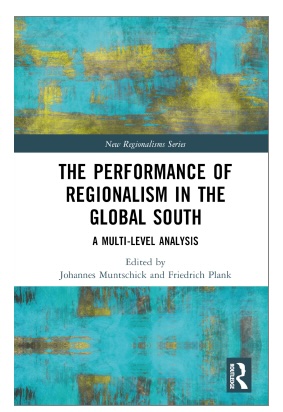
Professor Pascaline WINAND, Director of Studies in the European Interdisciplinary Studies programme at the College of Europe in Natolin, has recently published "The Performance of Regionalism in South Asia: SAARC and Beyond" chapter of an edited volume titled The Performance of Regionalism in the Global South. A Multi-level Analysis. The volume was edited by Johannes MUNTSCHICK, Friedrich PLANK, and was printed by Routledge.
In her chapter, Professor WINAND looks into the South Asian Association for Regional Cooperation (SAARC), which has generated innovative ideas, studies, proposals, reports, documents, declarations, agreements and conventions. It has a well-developed institutional structure with clearly identified priorities, programs and policies. Yet its implementation record has been limited, particularly in certain policy areas. To explain this uneven performance, the chapter first considers the sources of the regionalist cognitive prior of SAARC’s member states, their initial preferences at the time of SAARC’s creation and how these informed the design and the limitations of its Charter.
It then examines SAARC’s capacity for adaptation and reform of its organizational processes as well as its confidence-building role in South Asia. It next turns to its performance in security and trade, as well as the output of three specific projects: the planned SAARC satellite, the Covid-19 Emergency Fund and the South Asian University. The chapter then considers the transformative unintended consequences of SAARC’s existence in South Asia. This includes generating non-official dialogues, the creation of People’s SAARC, as well as the strategies of SAARC member states in addressing its limitations via subregional and overlapping, multi-membership regional strategies.
Please note that the views expressed in this publication are those of the author, and do not represent the official position of the College of Europe.