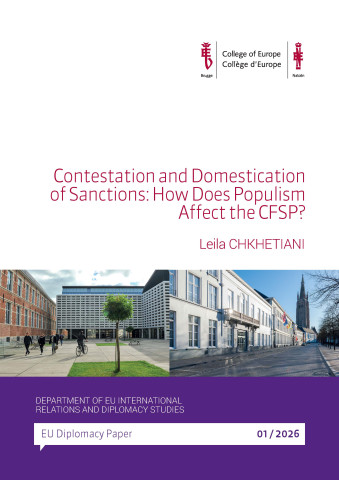
EU Diplomacy Paper 1/2026
The Department of EU International Relations and Diplomacy Studies has published a new EU Diplomacy Paper entitled "Contestation and Domestication of Sanctions: How Does Populism Affect the CFSP?"...
Master of Arts in European Interdisciplinary Studies at the College of Europe in Natolin will seek to give you a broader perspective by:
adopting a problem-based and truly interdisciplinary approach by integrating knowledge from a wide spectrum of disciplines, such as political science, law,
economics, sociology, history, philosophy, and international relations, to help grasp the full complexity of studied phenomena
offering a comprehensive and innovative curriculum delivered by a flying faculty of academics and practitioners, featuring a variety of learning formats, including masterclasses, workshops, simulation games, compact seminars, and tailored-made and week-long field trips
providing a better understanding of the historical, political, economic, social, and cultural dynamics of selected European regions, including Northern, Central, and Eastern Europe, the Mediterranean, and the Balkans, through the European Regional Studies component
Our academic programme employs an interdisciplinary approach to assist you in building a solid foundation to explore Europe’s key challenges and developments, and to allow you to develop you own areas of expertise. The programme starts with a combination of introductory courses in EU Legal Order, EU Institutions and Decision-making, European Economic Governance as well as History of European Civilization. These courses combined with the offer of the European Regional Studies programme lay the groundwork for a deeper specialisation within the year-long study tracks.
In 2027–2028, the European Interdisciplinary Studies programme will feature four year-long study tracks providing expertise on the issues shaping Europe’s future:
European Security and Strategy Study Track
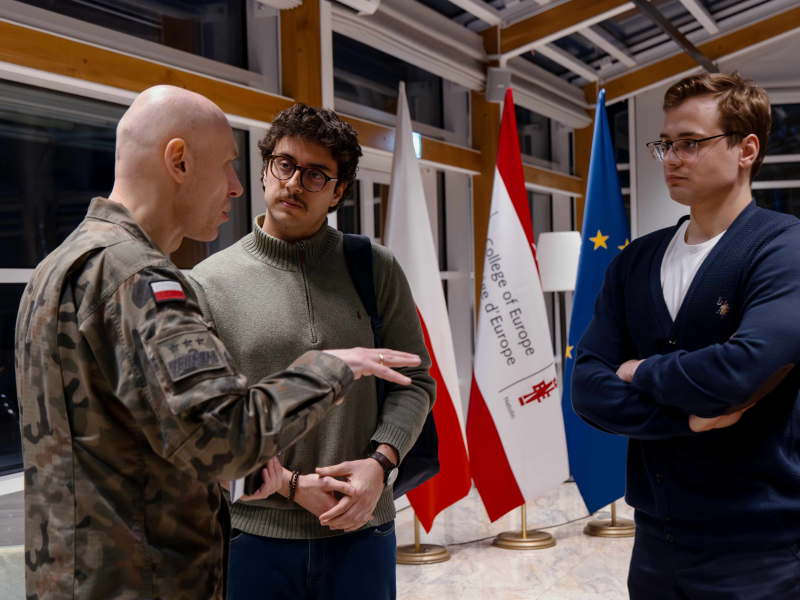
Migration, Policies and International Cooperation Study Track

The European Union and the World Study Track

Growth, Competitiveness, and Cohesion in Europe

The academic offer is enriched by a Capacity Building programme offering training, encounters with experts and thematic learning communities (Nests) equipping students with career-oriented skills.
Natolin’s unique campus environment fosters cross-cultural exchanges further reinforced by intercultural workshops and language courses in eight languages.
120+ Students from 30+ Nationalities
Flying Faculty of 120+ Academics and Practitioners
Field Experience: 2 Thematic Study Trips
Grounded in History
4 New Study Tracks
European Regional Studies
Capacity Building Programme
Language Courses in 8 Languages

The Department of EU International Relations and Diplomacy Studies has published a new EU Diplomacy Paper entitled "Contestation and Domestication of Sanctions: How Does Populism Affect the CFSP?"...