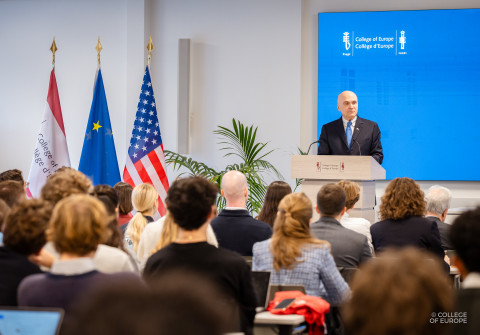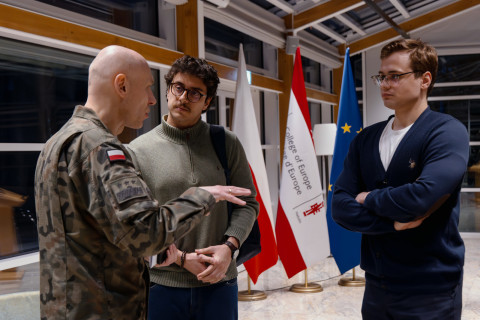
The track addresses some of the most pressing contemporary challenges for Europe and the EU. Wars erupting on the EU’s external borders and within its neighbourhoods are a stark reality, carrying long-term and significant implications for the EU, its Member States, and its institutions. The specialization builds on the unique geographical focus and the wealth of expertise accumulated at the College of Europe in Natolin over the past two decades.
The study track combines an interdisciplinary understanding of Europe’s internal and external dimensions with advanced analysis of security, defence, military, and power dynamics, as well as strategic reasoning and decision-making.
Academic Programme
MA in European Interdisciplinary Studies: European Security and Strategy Study Track
The College of Europe reserves the right to modify its academic programme subject to the decisions of its Academic Council.The study programmes are reviewed annually to ensure their continued quality and relevance.
1ST SEMESTER
Introductory courses
- BOBROWICZ, B. – Introduction to Economics
- BUTTERWICK-PAWLIKOWSKI, R. – History of European Civilization
- CHRISTIE, E. H. - Elementary Foundations in Economics and Econometrics
- HAMMAMI, A.; STEINGASS, S. – Introduction to Political Science
- SCHIRMANN, S. – L'Histoire de la construction européenne
- SCHUMACHER, T. – Introduction to International Relations
- SZOSTAK, R. – Introduction to Interdisciplinarity and Transdisciplinarity
- VAN ELSUWEGE, P. – Introduction to Law
- WESSELS, W. – Introduction to Theories and Strategies of European Integration
Core Courses
European Regional Studies
- BUTTERWICK-PAWLIKOWSKI, R. – East-Central Europe, 1815-1940 (14h)
- MINK, G. – L'Europe centrale et orientale depuis 1940 (16h)
Pluridisciplinary Foundation
- LORD, C. – EU Institutions and Decision-making (20h)
- VAN ELSUWEGE, P. – The EU Legal Order: Rights, Norms and Values (20h)
- WESSELS, W. – EU Economic Governance (20h)
Interdisciplinary Foundation
- AUER, S. – The Sources of EU Power in Times of War (20h)
- HEUSER, B. – Theories of War and Dimensions of Strategy (20h)
- SLOAN, G. – Geo-politics (20h)
Contextual Courses
- ALI, A. – The Use of Force in International Law (10h)
- DAOU, F. – Ethics and Religion in Armed Conflicts (10h)
- MILEVSKI, L. – Making Sense of Military Strategy (8h)
- SCHLENKER, D. – External Relations, Security and Defence through the Prism of EU Historical Documents (10h)
- WIGELL, M. – Geo-economics (10h)
European Regional Studies
- CICHOCKI, M. A.; DĘBSKI, S. – Cold War Strategies from the Central Eastern Europe Perspective (10h)
Masterclasses
- ANDRZEJCZAK, R. – Military Strategy (8h)
- LUNGESCU, O. – Communicating Security (6h)
Simulation Games :
- MINK, G.; CICHOCKI, M. A. – Drafting a Peace Treaty for the End of the Cold War (10h)
- BUTTERWICK-PAWLIKOWSKI, R. – The Paris Peace Conference of 1919-20 (10h)
Master’s thesis and Research strategies and tools
In addition to the courses they take during the first and second semesters, students must write and defend a Master’s thesis in English or French.
- STEINGASS, S. (coord.); BOBROWICZ, B.; CHABAN, N.; EXADAKTYLOS, T.; LONGHURST, K.; MINK, G.; ROZUMALSKI, J.; SZOSTAK, R.; VAN ELSUWEGE, P.; VANNONI, M.; WINAND, P. – Research Strategies and Tools (20h)
- Master Theses Colloquia
Study trip
The first semester study trip offers students a deeper understanding of European identities and a first-hand experience of policies in practice at the EU’s borders. The study trip is an integral part of the academic programme, participation is obligatory and students are expected to attend all related conferences and activities.
2ND SEMESTER
Specialist Courses
European Civilisation
- CICHOCKI, M. A. – From the Greek Agora to the Ukrainian Euromaidan and War: the History of Ideas of Democracy in Europe (20h)
- LEWIS, M. A. – Crimes against Humanity, Genocide, and International Justice (20h)
- MINK, G. – Histoire, mémoire, usages et mésusages politiques, de la Seconde Guerre mondiale à Poutine (20h)
- MOORHOUSE, R. – Totalitarian Ideologies and Dictatorships in Twentieth-Century Europe (20h)
- SEGRETO, L. R. – Europe and the Global Economy from the Industrial Revolution to the Internet (20h)
- STODDARD, E. – Changing Character of Warfare from Antiquity to the Present Day (20h)
- WONGSURAWAT, W. – The End of Empires: Decolonization of Asia with comparative references to Africa and Latin America (20h)
European Security Architecture
- TARDY, T. – L’environnement stratégique européen : évolutions et défis futurs (20h)
- POPOWSKI, M. - Building Resilience of the EU (20h)
- RILEY, A. – EU Security in an Economic Context (20h)
- Threats and Foresight
- GRESSEL, G. – Security and Conflict Management (20h)
- HEUSER, B. – Strategy, Planning, and Foresight (20h)
- JERMALAVIČIUS, T. – Terrorism and Hybrid Warfare (20h)
- MICHAELS, J. – Nuclear Strategy (20h)
- MICHTA, A. - Security and Military Challenges in Europe (20h)
Economics and Technology
- CHRISTIE, E. H. - Defence Economics and Defense Innovation (20h)
- JANKOWSKI, D. - The Geopolitics of Technology (20h)
Foreign Information Manipulation and Interference
- FREYTAG VON LORINGHOVEN, A. – Challenges of Multilateralism and Intelligence Cooperation (20h)
- KALENSKÝ, J. – The Geopolitics of Disinformation: Russia, the Neighbourhood, the Euroatlantic. What is the Threat and how to Counter it? (20h)
European Regional studies
Central Europe:
- DĘBSKI, S. – Between a Rock and a Hard Place: Central European Strategic Thought And Practice (20h)
- DUIJZINGS, G. – Flow and Friction along the Danube: Globalization and its Local Discontents (20h)
- PIĄTKOWSKI, M. – The Golden Age of Central Europe: The Path from Poverty to Prosperity and the Way Forward (20h)
Eastern Europe & Russia:
- GILES, K. – Contemporary Russian Foreign and Security Policy (20h)
- LANOSZKA, A. – War and Conflict in the Post-Soviet Space (20h)
- NOWAK, A. – Russian Ideologies: The Last Two Centuries (from Pushkin and Karamzin to Dugin and Putin) (20h)
- ONUCH, O. – Revolutions and Mass Mobilization in Eastern Europe (20h)
- TYUSHKA, A. – The EU, Russia and the EU’s Eastern Neighbourhood: Power, Performance, and Perceptions (20h)
- WILSON, A. – The Making of Modern Ukraine: History, Independence and War (20h)
- WOLCZUK, K. – State-building, Democratisation and Economic Transformations in Eastern Europe (20h)
Mediterranean:
- AYDIN, M. – Turkey Between Europe and Eurasia: Historical and Contemporary Evaluation (20h)
- BOURIS, D. – EU-Middle East Relations: Conflict, Peace and Security (20h)
- DEMMELHUBER, T. – Autocratization in the Middle East and North Africa: Transregional and Global Perspective (20h)
- LANNON, E. – The EU and its Southern Neighbourhoods (20h)
Balkans:
- LEWIS, M. A. – Politics and Diplomacy in the Balkans from the Nineteenth Century to the Present (20h)
- TEOKAREVIC, J. – Western Balkans: EU Enlargement, External Influences, Post-Conflict Transition (20h)
Nordics & Baltics:
- BERGMANE, U. – The Baltic Region from the Fall of the Soviet Union to the Enlargement of the EU and NATO (20h)
Compact Seminars
- CORFF, O. – China's National Security and Military Policy (8h)
- FRANZA, L. – Energy Security and Conflict in the EU’s Neighbourhood (10h)
- MUNOZ, R. – EU Space Policy (8h)
- VIMONT, P. – The EU and Crisis Management in Practice (8h)
- ZAMPIERI, F. - Maritime Geopolitics (8h)
European Regional Studies
Central Europe:
- PUDŁOCKI, T. – The Cultural History of Central Europe from Fin-de-Siècle to Totalitarianism (10h)
Eastern Europe & Russia:
- ISAACS, R. – Central Asia as the EU's Wider Neighbourhood: Power, Politics, and Foreign Policy (10h)
- SABADUS, A. – Opportunity in Adversity: Moldova’s way to energy resilience (8h)
Mediterranean:
- AL-SABBAGH, R. – Investigative Journalism in the Southern Neighbourhood (8h)
- SHEIKH, N. – Religion and the State in the EU’s Southern Neighbourhood: Politics, Authority, and Religious Movements in the Middle East and North Africa (10h)
- Nordics & Baltics:
- ALIYEV, N. – Geopolitics and Geoeconomics of the Arctic (8h)
Simulation Games
- TARDY, T. – NATO’s & the EU’s response to War in Europe (8h)
Cooperation with external partners
- MIKOS-SKUZA, E. – Introduction to International Humanitarian Law (17h)
- Workshops in history organized in cooperation with the Max Weber programme of the European University Institute (TBC)
Study trip
The second semester study trip offers theme-specific field trips in Europe and beyond. The study trip is an integral part of the academic programme, participation is obligatory and students are expected to attend all related conferences and activities.
Language courses
In addition to benefitting from a bilingual study programme, students can take advantage of language courses on offer implemented by the Languages and Intercultural Dialogue Office. The following languages are on offer: English, French, Italian, German, Polish, Russian, Spanish and Arabic.